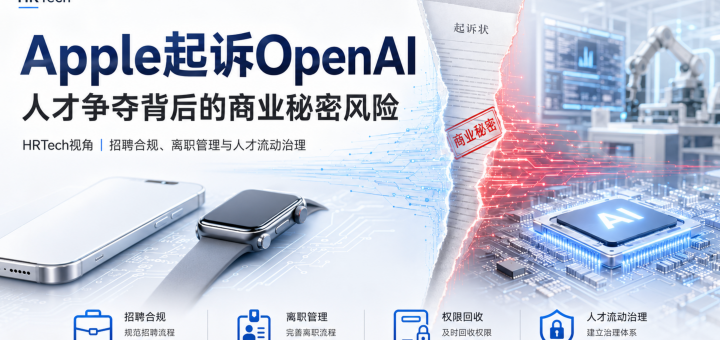
Apple 起诉 OpenAI 窃取商业秘密:一场由人才流动引发的硬件与组织治理危机Apple 指控多名前员工在加入 OpenAI 前后,非法获取并使用 Apple 的硬件研发、制造工艺与供应链机密。事件不仅是一场科技公司的知识产权诉讼,也暴露出 AI 人才争夺、员工离职管理和招聘合规中的系统性风险。
2026 年 7 月 10 日,Apple 向美国加州北区联邦地区法院提起诉讼,起诉前 Apple 员工 Chang Liu、Tang Yew Tan,以及 OpenAI Foundation、OpenAI Group PBC 和 io Products, LLC,指控其涉嫌盗用商业秘密和违反员工保密协议。
简单来说,Apple 的核心指控是:OpenAI 为了加快进入消费硬件市场,大量招募 Apple 的工程师和管理人员,而部分员工在离开 Apple 前后,涉嫌带走、下载或泄露 Apple 的内部文件、硬件设计资料、制造工艺和供应链信息,并将这些信息用于 OpenAI 的硬件研发和招聘活动。
目前,这些内容仍然是 Apple 在起诉状中提出的单方指控,尚未经过法院审理和认定。案件后续还需要经过被告答辩、证据开示、禁令听证和可能的庭审程序。
发生了什么:Apple 指控前员工离职后仍在获取内部资料
案件中最受关注的人物之一是 Chang Liu。Chang Liu 曾在 Apple 工作八年多,担任 Senior System Electrical Engineer,参与 iPhone 等敏感硬件项目。他于 2026 年 1 月 22 日离开 Apple,并加入 OpenAI。
Apple 称,Chang Liu 在离职过程中没有完成正常的设备归还和安全审查,也没有回应 Apple 关于离职面谈和保密义务的联系。Apple 进一步指控,他至少保留了一台 Apple 配发的工作电脑,并在离职后继续尝试访问 Apple 的内部系统。
2026 年 2 月 9 日前后,Chang Liu 据称发现自己仍然可以通过一个当时尚未被 Apple 发现的身份验证漏洞,访问 Apple 的云端网络存储系统。Apple 表示,他没有报告漏洞,而是在已经加入 OpenAI 的情况下,持续访问并下载 Apple 的内部资料。
Apple 称,被下载的资料包括未发布产品信息、技术演示文档、工程规格、项目数据,以及一套超过 1,000 页的技术文件。其中部分内容涉及主逻辑板,也就是 MLB 的制造流程、测试方式、设备选择和故障分析。
Apple 认为,这些信息并不是普通的员工工作经验,而是多年研发、制造和供应链投入所积累的商业秘密。
Apple 指控 OpenAI 将招聘面试变成信息获取渠道
案件中的另一名重要人物是 Tang Yew Tan,通常也被称为 Tang Tan。Tang Tan 曾在 Apple 工作约 24 年,最后担任 Vice President of Product Design for iPhone and Apple Watch。离开 Apple 后,他参与创办 io Products,后者于 2025 年被 OpenAI 以约 65 亿美元收购。Tang Tan 随后成为 OpenAI 的 Chief Hardware Officer。
Apple 指控,Tang Tan 和 OpenAI 的硬件团队在招聘 Apple 员工时,多次询问涉及 Apple 内部项目、产品代号和制造流程的问题。
起诉状称,OpenAI 要求部分候选人在面试中进行“Technical Deep Dive”,详细介绍其在 Apple 的工作,包括产品组件选择、CAD 工具、仿真软件、系统集成方法、供应商选择和制造协作流程。
更严重的指控是,OpenAI 面试人员曾要求 Apple 候选人携带实际零部件、样品、原型和设计资料参加面试,包括 Batteries、Systems-in-Package、main logic boards、shields、housings 和 back glass 等。
Apple 认为,这些面试要求已经超出了正常的人才评估范围,实质上是在利用招聘流程获取竞争对手的内部技术与产品信息。也有小道消息说是其与苹果9月新任CEO关系非常紧张。
前员工被指提前了解 Apple 的离职安全流程
Apple 还指控,Tang Tan 或 OpenAI 内部人员持有一份标注为“Need to Know”的 Apple 内部文件。
这份文件描述了 Apple 在员工离职时会采取哪些安全措施,包括设备检查、账户审查、取证流程和保密提醒。
根据 Apple 的说法,这份文件被提前分享给即将从 Apple 跳槽到 OpenAI 的员工,使其可以在正式提交离职申请前了解 Apple 的检查方式,从而规避安全审查。
Apple 还称,OpenAI 曾建议部分员工不要立即向 Apple 透露下一家公司是 OpenAI,并尽量争取正常的两周离职期,从而在离职前继续保留对 Apple 系统和资料的访问权限。
如果这些指控最终获得证据支持,这意味着问题可能并非个别员工的临时行为,而是已经涉及招聘、离职和人才引进流程中的组织性操作。
Apple 指控 OpenAI 利用其供应链和制造工艺
Apple 的诉讼并未停留在员工文件泄露层面。
Apple 还指控 OpenAI 和 io Products 利用前 Apple 高管掌握的供应商信息、内部术语和制造知识,接触 Apple 的长期合作伙伴。
其中一项指控涉及 Apple 的专有金属表面处理技术。Apple 称,OpenAI 或 io 要求一家 Apple 合作伙伴为其执行原本受严格保密协议约束的多步骤金属处理工艺,并让合作伙伴误以为这一行为已经获得 Apple 授权。
Apple 还表示,OpenAI 曾向参与电源、电池和制造设计的 Apple 供应商提出高度针对性的问题,而这些问题只有熟悉 Apple 内部技术和供应链体系的人才能提出。
从商业竞争角度看,这部分指控直接触及 Apple 最核心的竞争壁垒:不仅是产品设计本身,更包括如何制造、如何选择供应商、如何控制质量,以及如何实现全球规模化交付。
为什么这起案件对 HR 和企业管理具有重要意义
从 HRTech 的角度看,这起案件并不只是 Apple 与 OpenAI 之间的知识产权争议,而是一场典型的“人才流动风险事件”。
AI 行业正在以前所未有的速度争夺工程师、产品负责人、供应链专家和高级管理人员。当竞争从软件模型扩展到 AI 设备、芯片、机器人和消费硬件时,人才的价值已经不仅体现在个人能力,也体现在他们掌握的组织知识、技术路径和供应商网络。
企业面临的核心问题是:员工可以自由流动,但企业商业秘密不能跟着员工一起流动。
正常的职业经验、通用技能和行业知识属于员工个人能力的一部分。员工可以在新公司继续使用自己的专业判断、管理能力和工程经验。
但源代码、未发布产品信息、内部项目代号、具体设计图纸、测试数据、供应商合同、制造参数和专有流程,通常属于企业受保护的信息。两者之间的边界,正是许多公司在人才竞争中最容易忽视的地方。
HR 部门不能再把保密管理只交给法务和 IT
传统上,商业秘密保护常被视为法务或信息安全部门的职责。但从这起案件来看,风险实际上贯穿员工全生命周期。
风险从招聘开始。
当招聘团队要求候选人过度展示上一家公司的真实项目、代码、样品和内部文件时,企业本身就可能成为商业秘密侵权的参与者。
风险也存在于员工在职期间。
如果企业没有建立清晰的数据分级、访问权限和异常下载监测机制,即使员工已经提出离职,仍可能继续访问大量敏感资料。
风险更集中在离职阶段。
高风险岗位员工的权限关闭、设备归还、文件检查、个人邮箱转发记录和外部存储设备使用情况,都需要 HR、法务和 IT 共同管理。
风险还可能延续到新员工入职后。
新公司必须明确告诉员工,不得携带、上传或使用前雇主的机密资料,也不得在内部培训、产品设计或供应商会议中披露前雇主受保护的信息。
对企业 HR 的五项建议
第一,建立高风险岗位识别机制。
并不是所有员工离职都需要同样强度的审查。涉及核心研发、AI 模型、产品路线图、芯片、硬件设计、定价、客户数据、制造工艺和供应链关系的岗位,应被纳入高风险人员清单。
第二,把招聘合规写进面试流程。
企业应明确禁止面试官要求候选人提供前雇主的源代码、设计图、真实客户资料、内部文件、产品原型、供应商名单和未发布项目信息。
技术面试可以评估候选人的思考过程和专业能力,但不应要求候选人证明自己“掌握多少上一家公司的秘密”。
第三,强化离职前后的数据行为监测。
当员工提出离职或出现明显跳槽信号后,企业可依法加强对异常下载、批量复制、个人邮箱转发、外接设备使用和敏感文件访问行为的监测。
这一过程需要在适用法律、员工隐私政策和公司制度框架内进行,不能简单扩大为无差别监控。
第四,重新设计离职程序。
离职面谈不应只是薪资结算和设备归还。对于关键岗位,应加入商业秘密提醒、文件返还确认、系统访问终止、外部存储检查和持续保密义务确认。
第五,对新员工实施“干净入职”。
从竞争对手公司加入的新员工,尤其是高管和研发人员,应在入职时签署声明,确认不会携带、上传或使用前雇主的任何保密资料。
企业还应通过培训告诉管理者:不能因为新员工“知道很多”就鼓励其分享前公司的内部信息。
HRTech 可以如何帮助企业降低风险
这起案件也说明,员工离职管理正在从行政流程转变为数据治理和风险治理。
未来的人力资源系统不仅需要记录入职、转岗和离职日期,还需要与身份管理、设备管理、文档权限和安全监测系统连接。
例如,当关键员工提交离职申请后,系统可以自动触发一套风险工作流,包括权限复核、异常下载检查、设备归还任务、保密提醒和管理者确认。
招聘系统也可以加入面试合规提示,提醒面试官不得要求候选人披露前雇主机密,并对涉及“原型”“代码”“供应商名单”和“内部文档”等敏感内容的面试材料进行审核。
在 AI 时代,HRTech 的价值不只是提升招聘效率或员工体验,也包括帮助企业建立可审计、可追踪、可执行的人才风险管理体系。
结语
Apple 与 OpenAI 的诉讼最终如何发展,仍取决于后续证据和法院判断。
但这起案件已经给企业敲响警钟:当行业进入高强度人才争夺阶段,招聘速度、人才密度和技术能力固然重要,人才引进过程中的合规边界同样重要。
优秀人才可以带来经验、判断和创造力,但企业不能通过人才流动获取竞争对手的商业秘密。
对于 HR 而言,未来最重要的能力之一,不只是把人招进来,而是确保企业用正确的方式招人、用人和管理人员流动。
这既是法律风险问题,也是组织治理、雇主品牌和长期竞争力问题。
硅谷与华尔街人才争夺战的思考:金融与科技逐渐走向融合
编者按 : 埃里克·普瓦里耶(Eric Poirier)是 投资管理软件公司 Addepar 首席执行官。
戈登·盖柯(Gordon Gekko)的追求也折射出这代人中最具才华、最聪明的一批人的梦想。今天,优秀的大学毕业生不再将华尔街作为职场上的第一选择,而是纷纷涌向硅谷和其他顶尖高科技中心,试图用改变世界的应用和机遇来挑战现状,给这个世界带来真正且持久的影响。有关“硅谷与华尔街人才争夺战”的讨论热度仍然不会消减,而且根据常理,你一定会被吸引到硅谷,从事对这个社会很有意义的工作。
这种说法越来越常见,但准确吗?答案也很简单,不准确。这种争论往往会以“我们 PK 他们”的心态展开,这种心态具有误导性;事实是,一些看似毫不相关的行业,却得益于新出现的机遇和金融科技领域的创新,越来越有可能走到一起。
不过,在深入探讨这个问题之前,我们先来看一看引发“硅谷 PK 华尔街”讨论的相关统计数据。
条条大路通硅谷?
科技行业正在走向复兴,而且当前这个阶段完全可与受到互联网热潮推动的 20 世纪 90 年代末期和 21 世纪初期的科技繁荣时期相媲美。涌向科技行业的毕业生比例 逐年稳步上升 ,就如同 越来越多的学生进入 STEM(科学、技术、工程和数学)领域一样 。
另一方面,美国顶尖大学中从事金融工作的 MBA 比例却逐年下滑,即便金融行业已经从 2008 年金融危机的阴影中走了出来。例如,在 2013 年哈佛大学商学院的毕业生中,最终只有 27%的人从事金融工作,这一比例甚至低于 2008 年和 2009 年金融危机最为严重的时候。
这些数字进一步模糊了金融与科技之间日益密切的联系,这种联系在对金融科技投资的快速增长中体现地尤为明显。根据 Accenture 的最新调查结果, 全球金融科技在 2014 年获得的风险投资已经突破了 120 亿美元 ,大概是金融科技公司在 2013 年获得的投资(40.5 亿美元)的 3 倍。这充分表明金融服务行业正在越来越多地采用新兴技术,而科技行业与金融服务行业之间的相互依赖越来越明显。
有鉴于此,核心问题也就变成了金融服务机构如何才能吸引那些最近流向硅谷创业公司的年轻人才,如何才能充分利用金融科技当前不错的发展势头。
与金钱无关
简而言之,千禧一代人觉得,他们可以在科技行业发挥最大的作用;在科技行业,创新无处不在,非传统思维也成为最新时代思潮的一部分。随着大学生的职业目标从常春藤联盟转向谷歌园区,以及他们纷纷加入前途远大、有机会成为“下一个大事件”的创业公司,很显然科技行业已经超越金融行业,成为一个对众多顶尖院校毕业生更具吸引力的地方, 即便科技公司的平均收入仍然低于大多数金融服务机构 。
这最后一点不应该被忽略。尽管工资以及相关金融期权仍然是主要的招聘工具,但毫无疑问,有才华的毕业生进入就业市场的方式正在发生变化。
除了收入,他们还希望自己的人生更有意义:参与打造某种新的东西,或是改变某个进程的基本性质。金融服务一般被看作是一个广阔市场内更为传统的行业,如今,谷歌、苹果、Facebook 和各种各样的小型创业公司经常被打上“创新”和“灵活”这样的标签,但在我们提到大型金融服务机构时,却极少会用到这样的字眼。
这并不意味着金融服务机构吸引后备人才的关键,在于改变他们的“休闲星期五”(Casual Friday)政策(这是一种几乎完全遭到华尔街排斥的做法),而是更多地与改变组织构建和运营的方式有关,鼓励他们在科技利用方面更加灵活,对改变传统流程的态度更加开放。科技如今是而且一直是支撑金融行业发展的重要推动力。
因此,金融服务机构越来越侧重于转变外界对他们的误读,即他们厌恶改变,崇尚“尝试、失败、再尝试”的理念,这种理念已经深深扎根于硅谷和其他高科技中心。在硅谷创业公司工作,意味着你可以直接对社会带来影响,以有意义的方式“拥有”成果,相比之下,华尔街传统上给人的感觉更官僚。
合二为一
放眼未来,几年内我们会看到金融和科技的联系越来越大——到时做一些你既感兴趣又有意义的工作,就不一定是在硅谷了。
这篇报道的内容已经开始有所体现。我们可以看到,除了传统上的风险投资公司,传统金融服务机构(如摩根大通、 Fidelity 和 T. Rowe Price),也越来越多地参与到快速增长的私营科技公司的大规模融资中来。最近几年,IPO(首次公开募股)的比率一直在下降,因此, 共同基金和其他一些机构投资者不断转向私营科技公司 ,寻求提升回报率的方法,这确实是合理的选择。
同时,硅谷的公司也在改变针对消费者的金融服务流程,为了完成这些流程,他们开始与银行系统合作,而不是竞争了——这种趋势越来越明显。变化最明显的是借贷、支付和加密货币领域,Prosper 和 Coinbase 等公司身上就在发生着这种变化。
在这个信息时代,金融领域未来的领导者已经不像从前了。他们是一个按需团体,习惯于看到立竿见影的效果。如果需要做出改变,那么就可以进行改变。如果一项计划庞大且无效率,那么就需要放弃它而制定更简单的方案了。
金融服务相对于其他行业更加顽固,不愿改变现状,这已经不是第一次了;就在 30 年前,场内交易的自动化是不可想象的(还有人记得那种公开喊价的方法吗?)。今天,在很多大型交易中,很难再找到场内经纪人了。同样,在出现彭博终端(Bloomberg Terminals)之前,也很难想象华尔街的作用不可动摇——但是,交易者们曾经要用笔和纸谈论股票的价格,现在只能通过手机进行交易。
现在,金融领域进行着同样的争论,而且声音越来越大。金融服务组织机构的各个阶层都出现了新一代的投资者和经纪人,我希望看到 20 年来我们熟悉的世界也发生同样的巨变。
现在是那些金融机构愿意放弃“我们 PK 他们”心态(这种心态源于硅谷和华尔街之间的较量)的绝佳时机,他们可以成为具有深远意义的合作伙伴:科技人员和金融人员一起工作的话,他们的效率会更高,工作方式也会更透明。这种新思维必将推动新技术的推广。
毫无疑问,时代在变;那些能更快意识到这种现实并顺势而为的人,将在竞争中占据优势。
A Closer Look At The Silicon Valley Vs. Wall Street Talent War
Eric PoirierCrunch Network Contributor
Eric Poirier is the CEO of investment management software company Addepar.
How to join the network
Gordon Gekko is but a distant blip in the rear-view mirror for this generation’s best and brightest. In lieu of Wall Street, today’s top graduates are flocking to Silicon Valley and other top technology hubs in droves, drawn in by visions of challenging the status quo with world-changing apps and the opportunity to make a real, lasting impact in the world. Talk of the “SiliconValley vs. Wall Street Talent War” continues unabated — and popular wisdom suggests that you need to be anchored in Silicon Valley to do meaningful work these days.
While it’s an increasingly common narrative, is it accurate? In a word, no. The “Us vs. Them” mentality that this debate often takes is misleading; the reality is that there is an increasing opportunity for seemingly disparate sectors to unite through the budding opportunities and innovations in fintech.
Before digging into that, though, let’s look at some relevant statistics that fuel the “Silicon Valley vs. Wall Street” debate.
All Roads Lead To Silicon Valley?
The technology sector is experiencing a renaissance that rivals even the frenzied, dot-com-driven heights of the late 1990s and early 2000s. The rate of graduates flocking to technology has steadily increased on an annual basis — as has the number of students enrolling in STEM fields.
The rate of MBAs from the nation’s top universities who go into finance, on the other hand, has been shrinking on an annual basis, even as the sector has largely recovered from the 2008 crisis. Consider, for instance, that 27 percent of graduates from Harvard Business School entered finance in 2013 — a lower rate than during even the depths of the recession in 2008 and 2009.
These numbers obscure the broader marriage between finance and technology, which can be evidenced in the massive growth of investments in financial technology, or fintech; according to a recent Accenture study, global investment in fintech ventures topped $12 billion in 2014 — more than three times the $4.05 billion invested in fintech companies in 2013. This is indicative of the financial service industry’s increasing adoption of emerging technology, fostering a greater interdependence between the tech and financial services industries.
With this in mind, the question shifts to what financial services institutions can do to attract more of the young talent that has recently gravitated toward Silicon Valley startups, and how they can harness the momentum of fintech in particular.
It’s Not About The Money
Simply put, the tech sector is where millennials feel they can make the most impact. It’s where innovation happens and outside-the-box thinking is part of the current zeitgeist. Be it transitioning from an Ivy League campus to the Google campus or joining an up-and-coming startup with a chance to become the next big thing, the tech sector has clearly surpassed finance as the more appealing career path for many graduates of top institutions, even if the average tech salary falls short of those offered by most financial institutions.
Working at a Silicon Valley startup allows people to have a direct impact and “own” results in a meaningful way, whereas Wall Street is traditionally more bureaucratic.
This last point is not to be overlooked. While salaries and associated financial options remain a major recruiting tool, there has undoubtedly been a change in the way talented graduates are approaching the job market.
More than salary, they want to be impactful: a part of building something new, or changing the fundamental nature of a given process. Financial services is generally seen as one of the more traditional, if not lucrative, industries within the broader market — but it’s rare that you see the words “innovative” or “agile” mentioned in context with a large financial institution in the way that you do with a Google, Apple, Facebook or any host of small startups.
This is not meant to say that the key for financial services institutions looking to lure back talent is simply a matter of changing their Casual Friday policies (a practice Wall Street has almost universally rejected, anyway). It’s more a matter of changing the way organizations are structured and operated, and encouraging more agility in terms of technology adoption and an openness to changing long-tenured processes. Technology is and has always been a critical enabler of finance.
Financial institutions are thus increasingly focused on shifting the perception that they are change-averse and embracing the “try and fail and try again” ethos that has permeated SiliconValley and other high-tech hubs. Working at a Silicon Valley startup allows people to have a direct impact and “own” results in a meaningful way, whereas Wall Street is traditionally more bureaucratic.
When Two Become One
The coming years will see a deepening of the relationship between finance and tech — and a broader acknowledgement that you don’t have to be based in Silicon Valley to do interesting and meaningful work.
The writing is already on the wall. Consider the uptick in traditional financial institutions like J.P. Morgan, Fidelity and T. Rowe Price increasingly participating in high-profile funding rounds for fast-growth private tech companies in addition to (and often in place of) traditional venture capital firms. The rate of IPOs has slowed in recent years, so it makes sense that mutual funds and other institutional investors are increasingly turning to private technology companies as a means to boost returns for investors.
There’s also an increasing trend of Silicon Valley companies that are changing consumer-facing financial services processes and working with, not against, banks to do so. This is most notably happening in the lending, payments and crypto-currencies spaces, with companies like Prosper and Coinbase.
The future leaders of finance have been weaned during the Information Age. They’re an on-demand group accustomed to seeing immediate results. If a change is needed, it can and will be made. If a design is bulky and inefficient, it’s time to blow it up and develop something simpler.
This isn’t the first instance in which financial services have been more change-averse than other industries; just 30 years ago, it was unthinkable that floor trading would be automated (anybody remember the Open outcry system?). Today, you’re hard-pressed to find a floor broker at many of the major exchanges. Likewise, it’s hard to imagine that Wall Street existed before the advent of Bloomberg Terminals — but there was once a time when traders were indeed forced to price bonds with pencil and paper, and trade exclusively over the phone.
The same type of conversations are happening in finance today, and they are becoming louder and louder. A new generation of investors and brokers has penetrated the ranks of financial services organizations, and I expect a similar sea change from the world we’ve known for the past 20 years.
There’s a tremendous opportunity present for those financial institutions willing to push back against the “Us vs. Them” mentality currently ascribed to Silicon Valley and Wall Street, and instead embrace meaningful partnerships where the hoodies and the suits work together in a more impactful, transparent way that fosters increased adoption of new technology.
There’s no doubt that the times are changing; those who are quicker to recognize and adapt to this new reality will be the ones to come out on top.
来源:techcrunch

 人才争夺
人才争夺
 人才争夺
人才争夺
 人才争夺
人才争夺
 人才争夺
人才争夺
 人才争夺
人才争夺

 人才争夺
人才争夺





 扫一扫 加微信
hrtechchina
扫一扫 加微信
hrtechchina