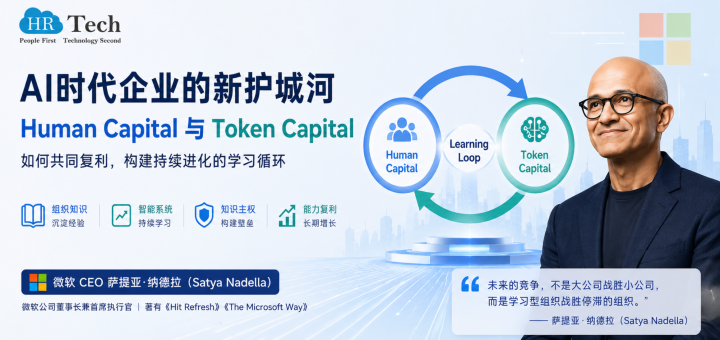
5000万人阅读的微软CEO笔记:AI时代,企业真正的护城河不是模型,而是Learning LoopHRTech概述:微软 CEO Satya Nadella 最近提出一个非常关键的AI时代企业判断:未来企业的护城河,不只是用了哪个大模型,而是能否拥有自己的 Learning Loop。企业需要同时建设 Human Capital 与 Token Capital。前者是人的知识、判断力、关系和创造力,后者是企业通过AI系统沉淀下来的智能能力资产。真正有竞争力的企业,不会把组织经验完全交给少数通用模型,而是把工作流、知识库、私有评估和组织记忆变成自己的AI能力。对HR来说,这意味着未来的核心工作,将从人才管理走向组织学习系统与人机协同能力建设。
纳德拉把AI讨论推进到企业未来形态层面
微软 CEO Satya Nadella 最近发布的长文《A frontier without an ecosystem is not stable》 (原文附录再最后),并不是一篇普通的AI趋势评论。它更像是微软在AI时代对“企业未来形态”的一次战略表达。文章中,Nadella提出了一个非常关键的判断:未来企业的竞争力,不会只来自某一个前言模型,而会来自一个更广泛、更稳定、更可持续的前沿生态系统。换句话说,AI时代最重要的问题,不是企业接入了哪个大模型,而是企业是否真正拥有自己的学习循环、知识主权和组织能力复利机制。
Human Capital 与 Token Capital 成为未来企业的两种核心资本
Nadella在文章中提出,未来每家公司都需要同时建设两种资本:Human Capital和Token Capital。Human Capital指的是人的知识、判断力、关系网络、创造力、模式识别能力和跨领域连接能力;Token Capital则是企业通过AI系统、Agent工作流、知识库、私有评估体系和组织数据逐步沉淀下来的AI能力资产。这个概念非常重要,因为它把AI从“工具”提升到了“资本”的层面。企业不再只是使用AI完成某个任务,而是要把AI变成一种可以持续积累、持续进化、持续创造价值的组织资产。
这不是岗位替代问题,而是企业如何保持差异化的问题
这也是Nadella观点中最值得HR和企业管理者关注的部分。过去几年,很多关于AI的讨论都集中在“AI会替代哪些岗位”“哪些工作会被自动化”“员工需要学习哪些AI技能”。这些问题当然重要,但它们仍然停留在任务和岗位层面。Nadella讨论的是更底层的问题:当AI开始吸收企业的工作流、知识、经验和判断时,企业如何继续学习、如何保护自己的IP、如何保持差异化,以及如何避免自身积累多年的行业经验被少数通用模型商品化。
HR需要进入人力资本与智能资本共同管理的新阶段
从HRTech视角来看,纳德拉真正传递的是一个信号:AI时代的企业管理正在从“人力资本管理”走向“人力资本与智能资本共同管理”。传统HR管理的是人,数字化HR管理的是流程和数据,而AI时代的HR将不得不参与管理组织学习系统。未来企业的核心问题不再只是“我们有多少人”“员工效率如何”“岗位如何配置”,而是“人的经验如何沉淀为系统能力”“组织判断如何进入AI工作流”“知识如何在员工与Agent之间持续循环”“企业是否拥有自己的Token Capital”。
AI越强,人的判断力越重要
Nadella反复强调,人类价值不会因为Token Capital增长而下降,反而会变得更加重要。这个判断非常关键。AI可以帮助企业完成分析、生成、自动化和执行,但AI本身不会自动决定企业的方向。真正设定目标、识别机会、判断风险、建立信任、连接资源、理解复杂组织语境的,仍然是人。也就是说,AI越强,人的价值越会从“执行任务”转向“定义问题、判断结果和承担责任”。未来组织中最重要的人才,不一定是掌握最多工具的人,而是能够把业务目标、组织经验和AI能力连接起来的人。
能力模型需要从岗位行为扩展到人机协作与知识沉淀
这对HR提出了新的挑战。过去,HR通常把能力模型建立在岗位职责和行为标准之上;未来,能力模型需要进一步延伸到人机协作能力、AI判断能力、知识沉淀能力和跨系统学习能力。一个优秀员工的价值,不仅体现在个人产出上,也体现在他是否能够把自己的经验转化为组织可复用的知识资产。一个优秀管理者的价值,也不只是带团队完成目标,而是能够让团队的经验进入系统,成为下一轮业务增长的训练信号。
Learning Loop 是企业AI护城河的核心
Nadella提出的Learning Loop,是这篇文章最核心的概念。企业真正的AI护城河,不是单次使用AI提高了多少效率,而是每一次工作是否都能反过来提升系统能力。以招聘为例,企业不能只让AI筛简历、写JD或安排面试,而应该把招聘结果、候选人质量、面试判断、入职表现、留任情况和绩效反馈连接起来,形成持续学习的闭环。这样,AI系统才会越来越理解这家公司真正需要什么样的人,而不是只根据通用标准做表面匹配。
从招聘到组织设计,所有关键管理场景都需要学习闭环
同样,在绩效管理、员工发展、组织设计和领导力培养中,企业也需要建立自己的学习循环。哪些团队结构更有效?哪些管理行为真正提升绩效?哪些培训内容能够转化为业务结果?哪些员工信号预示着离职风险或成长潜力?这些问题如果只是停留在报表和经验判断层面,价值会随着人员流动而流失;但如果能够进入知识库、评估体系和Agent工作流,就会逐渐形成企业自己的组织记忆。
Institutional Memory 让组织经验变得可查询、可调用、可扩展
这也是Nadella所说的institutional memory。传统企业最大的隐性损耗之一,是组织记忆无法被有效查询和复用。很多关键经验存在于资深员工、大区负责人、HRBP、业务主管和创始团队的大脑中。一旦人离开,知识也随之流失。AI时代的一个重大机会,就是让组织记忆变得可查询、可调用、可扩展。未来的新员工不必完全依赖口耳相传理解公司,管理者也不必每次从零开始判断复杂问题,企业可以通过AI系统调用过去的案例、判断逻辑、决策背景和业务结果。
企业不能成为少数通用模型的数据供应商
但Nadella同时提出了一个非常现实的警示:如果所有企业都只是把数据、流程和经验交给少数frontier models,那么长期看,企业可能会失去自己的知识主权。大模型越强,越可能吸收和商品化不同行业的专业经验。如果一家企业只是不断向外部模型输入自己的业务知识,却没有把这些知识沉淀到自己的系统中,那么它很可能从AI受益者逐渐变成AI平台的数据供应商。短期看,它获得了效率;长期看,它可能失去了差异化。
Frontier Ecosystem 比 Frontier Model 更接近稳定的AI经济结构
这也是为什么Nadella强调“frontier ecosystem”,而不是只强调“frontier model”。一个健康的AI经济,不能让所有价值都流向少数模型公司。真正可持续的结构,是每个公司、每个行业、每个国家都能在基础模型之上建立自己的学习系统、应用生态和知识资产。平台的价值,不应该只体现在平台内部捕获多少收益,而应该体现在它能够让多少企业在其之上创造更多价值。这一点也与微软长期强调的平台生态逻辑一致。
HRTech行业的竞争将转向组织学习系统建设能力
对HRTech行业来说,这篇文章的启发非常直接。过去HRTech产品的核心价值是流程数字化,包括招聘系统、绩效系统、学习系统、薪酬系统、员工服务系统等。AI时代,HRTech的竞争将进一步转向“组织学习系统”的建设能力。未来真正有价值的HRTech产品,不只是帮助企业完成一个流程,而是帮助企业把流程中的判断、知识和结果沉淀下来,并通过AI不断优化。
HRTech产品架构需要从记录与自动化走向评估、反馈和复利
这意味着HRTech厂商需要重新思考产品架构。第一,产品不能只是记录数据,而要理解数据背后的业务语境。第二,产品不能只是提供自动化,而要帮助企业建立可评估、可反馈、可改进的AI工作流。第三,产品不能只是接入大模型,而要帮助企业保留自己的领域知识、权限体系和组织记忆。第四,产品不能只关注单点效率,而要证明自己如何帮助客户形成长期Token Capital。
企业HR应从采购AI工具转向建设AI能力路线图
对企业HR来说,我们的建议是,不要把AI战略简单等同于采购工具。AI工具当然要用,但更重要的是建立企业自己的AI能力路线图。HR可以从三个层面开始行动。第一,盘点组织中的高价值知识和关键经验,尤其是招聘、绩效、人才发展、组织诊断、员工关系和管理决策中的隐性知识。第二,把关键工作流改造成可记录、可反馈、可评估的流程,让每一次业务实践都能成为未来系统优化的输入。第三,建立跨HR、IT、法务、业务部门的数据治理与AI治理机制,明确哪些知识可以进入系统、如何使用、如何评估、如何保护。
人才价值需要重新定义为个人绩效与知识资产贡献的结合
更进一步,HR需要推动企业重新定义人才价值。未来,一个员工是否优秀,不仅取决于个人绩效,也取决于他是否能够与AI协作,是否能够把经验结构化,是否能够帮助组织形成可复用的知识资产。一个HR团队是否先进,也不只是看是否使用AI工具,而是看它是否能够让组织经验持续沉淀,让员工判断被放大,让企业能力随着每一次使用而增强。
这不是效率革命,而是组织资本重构
Nadella这篇文章的价值,在于它把AI讨论从“效率革命”提升到了“组织资本重构”。AI不是简单地替代工作,也不是简单地提升生产率。它正在改变企业学习、知识积累和价值创造的方式。未来企业之间的差距,可能不在于谁最早用了AI,而在于谁最早建立了Human Capital与Token Capital之间的复利机制。
HRTech的新机会窗口正在打开
对HRTech而言,这正是新的机会窗口。谁能够帮助企业管理好人的经验、组织知识和AI能力之间的循环,谁就可能成为下一代企业AI基础设施的一部分。未来的HR,不只是人力资源管理者,也将是组织学习架构师、知识资产管理者和人机协作系统设计者。
稳定的AI未来,需要每个组织拥有自己的Learning Loop
最终,Nadella所说的稳定AI未来,不是少数模型捕获全部价值,而是让每个组织都拥有自己的学习循环。对企业来说,这是一种新的竞争战略;对HR来说,这是一场能力体系的重构;对HRTech行业来说,这可能是下一轮真正的产品分水岭。
附录原文:
Satya Nadella
@satyanadella
A frontier without an ecosystem is not stable
I’ve been thinking a lot about the future of the firm in an AI-driven economy.
This transition is different than any previous platform shift. In the past, we used digital systems to enhance human capital. This is the first time we can create a real cognitive loop between people and digital systems. That is a mind-bender, because it changes how we even conceptualize work inside an enterprise.
What is at stake is not some digital tool or system and its use, but how organizations continue to learn, build IP, differentiate, and thrive in a world where AI models can continuously absorb the expertise of humans and organizations and commoditize it.
Every company is going to have to build what I think of as human capital and token capital. Human capital comprises the knowledge, judgment, relationships, ingenuity, and pattern recognition of its people, while token capital is the firm’s AI capability it builds and owns.
Importantly, human capital does not become less valuable as token capital grows. It only becomes more valuable! I believe human agency will be the driver of token capital growth. Humans will set ambitious goals, connect dots across domains, build relationships, and recognize patterns that matter most. Without human direction, you have compute running in circles.
This means the real opportunity is not in picking the best model but instead in building a learning loop on top of models where human capital and token capital compound. You can offload a task, or even a job, but you can never offload your learning. The future of the firm is the ability to compound that learning across people and AI.
This requires a new architectural approach where every business is able to build agentic systems that improve over time, while still retaining control over their IP. A company should be able to switch out a “generalist” model without losing the “company veteran” expertise built into their learning system. This is the key “test” of your control and sovereignty in the era ahead.
Companies need to turn their workflows, domain knowledge, and accumulated judgment into AI systems that improve with each use. Private evals should capture whether a model is actually improving against outcomes that matter to the business (not just external benchmarks!). Private reinforcement learning environments should let models grow stronger on real traces from inside the organization. Its knowledge base makes institutional memory queryable and use of tokens more efficient.
This loop becomes the new IP of the firm. I think of it as a hill climbing machine. And unlike most assets, it compounds. Every improved workflow generates better training signal, which accelerates the accumulation of tacit knowledge unique to the firm. The companies that build this early will have an advantage that is hard to replicate, regardless of any new individual model capability.
The last thing any of us want is a world where every company across every sector is ceding value to a few models that eat everything they see. If all the value is accrued by only a few models, the political economy will simply not tolerate it. There is no societal permission for an AI future that hollows out entire industries.
Think about what happened in the first phase of globalization where entire industrial economies were hollowed out by outsourcing. The GDP numbers looked fine on the surface, but the displacement was real and the consequences are still being felt. Let us not bring that dynamic into the AI era, with a small number of AI systems capturing all the economic returns, while entire industries find their knowledge commoditized right out from underneath them.
In my view, our priority has to be building a frontier ecosystem, not just a frontier model, so value flows broadly across every company, every industry, and every country. One where every organization can own the learning loop that encodes its institutional knowledge, compounding its human and token capital.
This is the ethos I’ve grown up with where platforms enable more value on top than is captured inside, and where every company can continuously innovate and build value of its own.
When that happens, companies will create value for themselves and for the economy around them. Employees will see their expertise amplified and their judgment become part of systems that make it replicable and scalable and the benefits accrue to the companies and communities around them.
That is how companies drive value for themselves and the broader economy. And it is the stable equilibrium we should build together.

 扫一扫 加微信
hrtechchina
扫一扫 加微信
hrtechchina